Pages

Saturday, February 22, 2014

I/D1: Unit N How do SRT and the UC relate?

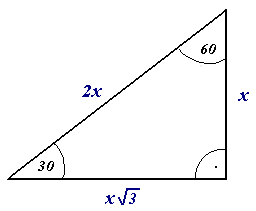
(http://upload.wikimedia.org/wikipedia/commons/1/15/Triangle_30-60-90_rotated.png)

Inquiry Activity Summary

1. The triangle above is a 30 degree triangle, the numbers around the edges are used as r (2x) x (y) and x rad 3(x). When we are using the ordered pairs we make r equal one and change the others so that the x remains the same.


(http://www.biology.arizona.edu/biomath/tutorials/trigonometric/graphics/trig_45_45_90.gif)


2 The triangle to the left is a 45 degree triangle, and the major difference from the 30 degree triangle is that the x and y for this one are the same, we still want to have r be equal to 1.


(https://encrypted-tbn1.gstatic.com/images?q=tbn:ANd9GcSUNhcyisjWpCaS61paVeoUvRYhYy01bc8iwclnXcNPlLpNSqoxfQ)


                3. This is the 60 degree triangle which is similar to the 30 degree triangle, we can see that the x and y are switched.


(http://literacy.purduecal.edu/STUDENT/mrrieste/quadrant1.png)
(http://1.bp.blogspot.com/-
Hr1ntVrUUK0/UF3p3LuRbLI/AAAAAAAAB5M/NMsjZCmV_vk/s1600/complete+unit+circle.jpg)

4. These three triangles are basically the thirst quadrant of the unit circle. And the ordered pairs shown in the picture are the x and the y of the triangles.  And all over the unit circle are just the same triangles and the same ordered pairs, just different signs.


5. The same triangles go all the way around the unit circle, as we can see from the image to the left, the values obtain different signs when they are in different quadrants. In quadrant 1 they are all positive, in quadrant 2 the x's are negative and the y's are positive. In the 3rd quadrant they are both negative and in the 4th quadrant the y's are negative and the x's are positives.


Inquiry Activity Reflection
1. The coolest thing I learned from this activity is that the lines on a unit circle are really all just the same three triangles all the way around.

2. This activity will help me in this unit because it made it easier for me to see that we add by 30 or 15 or 60 because these are the degrees of the three triangles.

3. Something I never realized about the special right triangles was that the ordered pairs on the unit circle are just the x and y after we make r equal to 1.


Works Cited 
1. http://upload.wikimedia.org/wikipedia/commons/1/15/Triangle_30-60-90_rotated.png
2. http://www.biology.arizona.edu/biomath/tutorials/trigonometric/graphics/trig_45_45_90.gif
3. http://literacy.purduecal.edu/STUDENT/mrrieste/quadrant1.png
4. https://blogger.googleusercontent.com/img/b/R29vZ2xl/AVvXsEhH5ODpWbs47DCsR3WqGkJuxN_cT5GuWsgOW6jXXdLULLfVds02yP_m-PeVS6DOUus3XxYhrFd6MEgTPmPEE3YIpSrJKbrq0GqFIjenPq7gDV21eErAVpSWVSTY3O29AxQqIt9w3wRaha4T/s1600/complete+unit+circle.jpg
5. https://encrypted-tbn1.gstatic.com/images?q=tbn:ANd9GcSUNhcyisjWpCaS61paVeoUvRYhYy01bc8iwclnXcNPlLpNSqoxfQ

Monday, February 10, 2014

RWA #1 Unit: M Concepts: 4-6 Conic Sections

1. Parabola- the set of all points equidistant from a given point, known as the focus and a given line, known as the directrix. 

2. -The formula for parabolas is: (x - h)^2 = 4p(y - k) or (y - k)^2 = 4p(x - h)


- In parabolas, the distance from the focus to the vertex, and the vertex to the directrix is known as 'p' this distance determines whether the parabola will be fat or skinny. In a parabola, the distance from the focus is the same for any given point. 'P' is also known as the focus.
"The line perpendicular to the directrix and passing through the focus (that is, the line that splits the parabola through the middle) is called the "axis of symmetry". The point on the axis of symmetry that intersects the parabola is called the "vertex", and it is the point where the curvature is greatest." (http://en.wikipedia.org/wiki/Parabola)
3. The picture above shows us where the vertex is located on the parabola, and the video also explains the other parts of the parabola and what their functions are.
- One of the most common uses of parabolas in the real world are roller coasters.They provide entertainment at amusement parks. Usually the roller coaster makes use of the outside of the parabola rather than the inside in order to be safer, the engineers have to be sure that the parabola is created well because is not, then it would not be safe.
As we can see int he picture below, there is a central support column which is where the vertex would be on a graph. There are only a couple supports because of the fact that because in parabolas the distance is the same from any point to the vertex, this means that if the engineers can create support columns in main parts of the roller coaster, then the parts that aren't supported by columns would be safe because the weight would be distributed equally.


4. Works Cited Page
  • https://blogger.googleusercontent.com/img/b/R29vZ2xl/AVvXsEhvUoSGMbXCs7QfRZpJXFcLZexCyNN_4m3N6PR2ffMCfUey4Q6R1PwBsLfc9AQwMhI7IYQqYGbLh3cxiU75eDxIwZw1hpNrfVCxUc_YNgDfJfGF0sAVU5mH9bS6T-9fNVmDI9_eoL7CZXI/s1600/Screen+shot+2012-05-08+at+1.37.57+PM.png
  • https://blogger.googleusercontent.com/img/proxy/AVvXsEi8RkhF1jy4qFSi00Iv5A3INwo1BwYS92aOT4o32L_eDFf1FjMSGJxcxjF5x9Xt18uci0vxnXKhnO5f93h6i8XytctCKRQ7ycr6KtUCIavZhlJuKTABOv6lMeYEv2-Fdi0jWjuRD25qfN9jyeBz1iXFZ6USitHwlGqCt2uHkNIIxv7Y_POTodU=
  • http://mathforum.org/mathimages/index.php/Parabola
  • http://youtube.com/parabolasdetailsections/


Sunday, December 8, 2013

SP #6 Unit K Concept 10

For this problem we have to first set it up correctly, as I did; .17 , .0017 , .000017 (adding place holders to the numbers already used and not worrying about the numbers that don't repeat until the end) We also have to remember our formula S sub infinity = a sub 1/ 1- r

Saturday, November 30, 2013

Fibonacci Haiku Food

http://www.google.com/imgres?imgurl=&imgrefurl=http%3A%2F%2Fclipartpin.com%2Fthanksgiving-turkey-clipart-6.html&h=0&w=0&sz=1&tbnid=jk4mgzhYk5gCDM&tbnh=189&tbnw=267&zoom=1&docid=nAptxiNT-cQqWM&ei=ozWaUpjzCY_noAT81YCgCg&ved=0CAIQsCUoAA

Tasty
Food
All day
Just for me
No I won't share it
So stop asking and go get your own 

Friday, November 15, 2013

SP #4 Unit J Concept 5 Partial Fraction Decomposition

   For our first part, we have to find our common denominator. When we distribute, we have to multiply the bottom as well as the top by the same thing. Then we combine our like terms and we should end up with 6x^2 -5x -10/(x+1)(x+2)(x-2)

Next we have to set our variables and multiply to get the common denominator. Then we combine our terms and set it equal to our previous answer.


Then we set up our systems as matrices and use the rref option on our calculator. We should get these three answers.


This is the answer that we should get in the end. We should notice that this is the answer that we started with. WE should be careful when we are combining all of our like terms.

Tuesday, November 12, 2013

SV #5 Unit J Concepts 3-4


The trickiest part to remember is when we have to do back substitution, we have to place the numbers in the correct spot and also with the correct sign.